


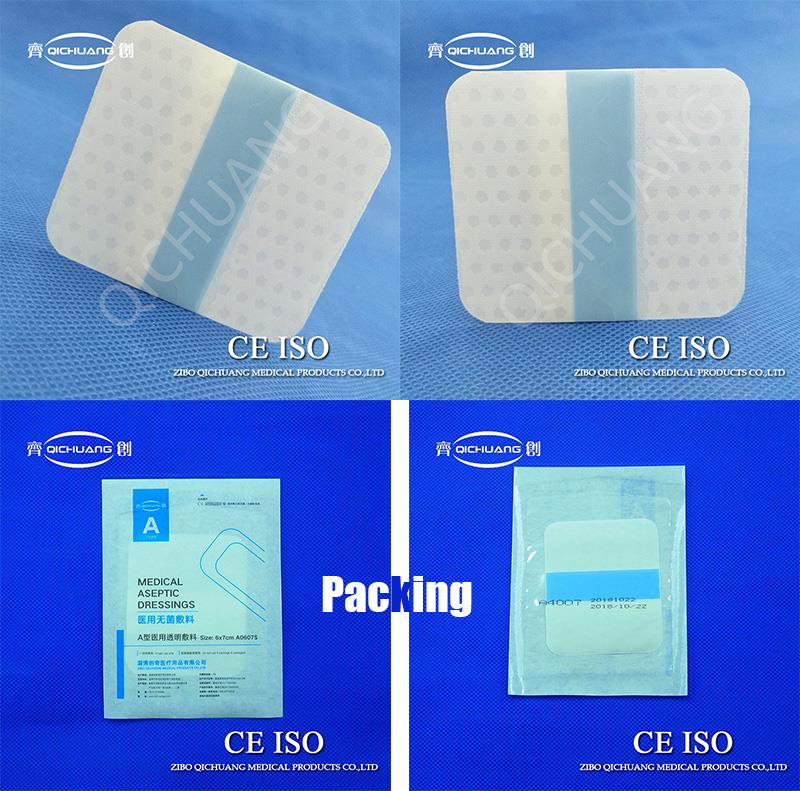
Zibo Qichuang Medical Products Co.,Ltd is one of the leading hospital medical transparent pu film semi-permeable dressing manufacturers and suppliers in China. Welcome to wholesale cheap medical products for sale here and get free sample from our factory. All customized products are with high quality and competitive price.

| Product name | Transparent Film Dressing |
| Item | A4008X |
| Size | 10cm x 12cm |
| Product composition | Release paper |
| PU film | |
PET Backing | |
| Tape Strip used for recording | |
| Application | Hospital, clinic, etc |
| Certificate | CE, ISO13485 |
| Producing capacity | 200,000 pcs/month |
| MOQ | 100 pcs |
| Packing | 1. Inner Packing: Paper plastic bag |
Outer Packing: Carton box | |
| 1pcs sterile bag, 100pcs per box | |
| 2. Custom-made Packing available | |
| Delivery time | Within 7--15 days for common size |
| Sample | Free |
| Customized design | Available |
| ODM/OEM | Available |
Peripherally inserted central catheters (PICC) provide direct access to the patient’s bloodstream and therefore pose a serious risk for infection from microorganisms introduced either at the time of insertion or while being cared for whilst in situ.
PICC dressing management should be performed by, or under direct supervision of, a healthcare worker who has the relevant knowledge, skills and training.
PICC dressing procedure
Equipment required for a routine dressing change
| Non-sterile gloves x 1 pair | 2% chlorhexidine in 70% alcohol skin preparation |
| Sterile gloves x 1 pair | Needleless connector for each lumen |
| Medicated sponge for aseptic hand wash | Sterile dressing pack |
| Sterile hand towels x 1 | Large transparent semi permeable dressing |
| 10ml syringe x 2 | 10mls 0.9% normal saline x 2 |
| Needleless blunt connector x 2 (if required) | Adhesive securement device |
| Chlorhexidine impregnated sponge or dressing | 70% alcohol or 2% chlorhexidine & 70% alcohol impregnated swabs for disinfection of connectors/bungs |
| Plastic backed protector sheet | Waste paper bag/bin |
1.
• Ask the patient to state (and where indicated spell) their full name and date of birth. Always check this against the patient’s ID band.
• Check with the patient and/or the patient medical record written or electronic for any allergy to skin preparation solution or dressing products.
• Explain the procedure to the patient, including that the procedure will require the patient to remain still for the duration of the procedure, and obtain consent.
• Conduct patient assessment of compliance. If patient is disorientated, confused, or non compliant it is recommended that you seek additional assistance with this procedure.
• Perform hand hygiene.
• Don personal protective equipment (PPE) as required.
2.
• Measure external catheter length (exit point from skin to end of bung/connector)
• Compare with insertion measurement. If there is greater than 2cm discrepancy, report to treating medical team as the PICC line tip location requires investigation. Do not use pending review by medical team.
• Assess insertion site for any visible abnormalities e.g. redness, tenderness, swelling, or exudate. Gently palpate the insertion site and ask the patient if there is any tenderness or pain. If there are any abnormal signs or symptoms contact the treating medical team for a collaborative decision regarding intervention, including potential device removal.
3.
• Perform hand hygiene.
• Don non-sterile disposable gloves.
• Using an aseptic technique open the dressing pack and sterile items.
• Place a non-sterile blue plastic backed sheet under the arm to protect clothing and bedding from skin preparation solution run off.
4.
• Gently remove existing dressing, beginning at the device hub. Avoid inadvertently dislodging the catheter, as it may have adhered to the dressing.
• Hold the skin firmly and close to the transparent film edge to prevent the skin from tearing as the dressing is removed.
• Apply adhesive strip if required
5.
• Remove adhesive stabilisation device according to manufacturer’s directions for use. Remove gently; 70% alcohol maybe used to assist removal where required.
• Take care not to touch the insertion site at any time throughout this procedure.
• A subcutaneous stabilisation device is not removed with each dressing change.
• If sutures have been used, carefully assess their integrity. If loose, other methods of stabilisation may be necessary.
• Take care not to dislodge or accidently withdraw the unsecured catheter.
• Apply adhesive tape/ strip to hold the PICC to skin (if required).
6.
• Remove gloves, discard waste.
• Perform a one minute aseptic hand wash and dry hands with the sterile hand towels.
7.
• Don sterile gloves.
8.
• Remove chlorhexidine impregnated sponge (if present) with sterile forceps.
• Discard forceps.
• Inspect PICC insertion site for swelling, redness and exudate. If there is exudate present, swab the site for cultures as per local procedure.
9.
• Disinfect the insertion site with 2% chlorhexidine in 70% alcohol solution using a gauze swab from the dressing pack or a commercially pre-prepared sterile 2% chlorhexidine in 70% alcohol swab stick.
• Disinfection should be performed using a circular motion moving in concentric circles from the insertion site outwards, or basket weave pattern, as per manufacturer’s instructions.
• This step should be repeated a total of three times using a new gauze or impregnated sponge for each application, and each application should be allowed to air dry prior to the next application.
• Allow to air dry which may take approximately 30 – 60 seconds. Note: care should be taken not to dislodge the unsecured catheter
10.
• Apply the adhesive stabilisation device as per manufacturer’s instructions.
• Use skin preparation if supplied, prior to application of stabilisation device. Positioning tips:
• Take care when selecting the position of the PICC once dressed and secured.
• Keep the PICC away from the cubital fossa to prevent bending and fracturing. Bend the patient’s arm to ensure there will be no kinks or bends in the catheter.
• Keep the external length of the PICC away from the insertion site
• Do not allow the lumen to overlap the insertion site as this will cause irritation and increase the risk of infection.
• Position the bung on the outer portion of the arm to assist with accessing the bung and to prevent the PICC from rubbing against the chest wall.
• If possible, position the connectors/bungs downwards to prevent the weight of the line interfering with the seal of the transparent dressing.
11.
• Apply appropriately sized chlorhexidine impregnated sponge (if there are no contraindications)
• If a Biopatch® is used – the blue side should face up. Ensure 360 degree contact with the skin.
12.
• Apply a large semi permeable transparent dressing. The insertion site should be positioned in the centre of the dressing.
• The adhesive securement device must also be completely covered. Use an additional large semipermeable transparent dressing if required.
• Take care not to overlap dressings above insertion site.
• Gently press the transparent dressing to ensure firm skin contact.
• If adhesive tape/ strip was used – remove this now.


1. We are Manufacturer.
2. We have rich production experience, just do most professional products.
3. Price Advantage, no middleman and trade company earn profits
4. Total quality management system
5. Professional team



Hot Tags: hospital medical transparent pu film semi-permeable dressing, China hospital medical transparent pu film semi-permeable dressing suppliers, manufacturers, factory, PICC CVC Securement Device From 3M Tegaderm I V Advanced Securement Dressing, Adult IV breathable dressing, Bacteria resistant IV dressing, Sterile Transparent Island Dressing, Newborn Umbilical Cord Care Swimming Protect Dressing, Breathable Waterproof Transparent Dressing

